01
Complete beginners
Begin with approachable concepts and recognizable musical results.
Learn with structure. Play with freedom.
AI Piano Teacher is an interactive piano learning program with guided lessons, video and audio instruction, and a practical approach to learning piano.
For complete beginners, developing players, and returning musicians.
What it is
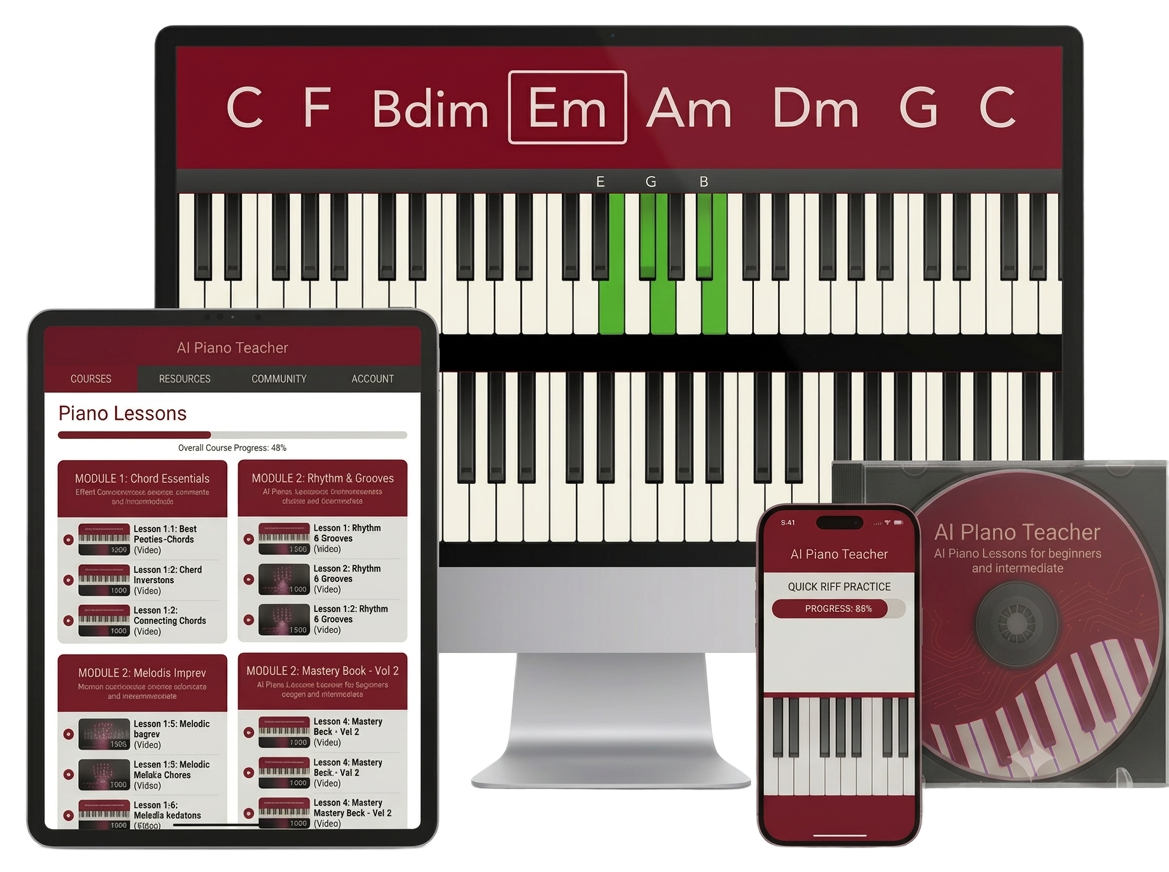
AI Piano Teacher combines structured piano lessons with practical instruction, video and audio learning, chords, musical patterns, playing by ear, music reading, and a range of piano styles.
The difference is in how those pieces connect. You do not spend months treating theory as a separate subject before you can make music. You meet a useful chord, rhythm, or pattern, see how it sits on the keyboard, hear how it sounds, and practise it in context. Written guidance, keyboard diagrams, notation, video, and audio work together so the lesson is not locked into a single way of learning.
That makes the course broad enough for somebody touching a keyboard for the first time and useful enough for an intermediate player who wants better chord knowledge, stylistic range, ear training, or creative confidence.
Who it is for
Complete beginners can build from simple rhythm and chord ideas. Developing players can fill gaps and expand into new styles. Returning pianists can rebuild fluency at their own pace. Guitarists and other musicians can transfer theory they already understand to the keyboard, while songwriters can use harmony, inversions, improvisation, and melody work to open new creative routes.
01
Begin with approachable concepts and recognizable musical results.
02
Strengthen chords, reading, rhythm, and stylistic versatility.
03
Rebuild comfort without pressure or a fixed lesson timetable.
04
Use piano for songwriting, arranging, improvising, and melody.
What you can learn
The curriculum covers chords, songs, rhythm, playing by ear, music reading, improvisation, songwriting, scales, exercises, and different piano styles. These are not presented as unrelated extras. Chord knowledge supports accompaniment; rhythm makes those chords musical; listening helps you recognize movement; notation gives you another route into a piece; and improvisation shows whether you can use an idea for yourself.
Chords
Rhythm & songs
Playing by ear
Music reading
Improvisation
Songwriting
1
Rhythm, basic chords, keyboard shapes, and practical playing.
2
Ballads, blues, rock, progressions, reading, and ear training.
3
Jazz, ragtime, improvisation, melody creation, and songwriting.
4
Advanced chords, scales, exercises, and classical material.
A different kind of lesson
Traditional sheet-music instruction often asks the eyes to do almost all the work. This course keeps reading in the picture but adds practical, visual, audio, and video-based instruction. A keyboard diagram can make an abstract chord concrete. A video can reveal movement. An audio example can clarify timing and feel. Written instruction can explain why the pattern works.
The emphasis is on patterns and actual playing: recurring shapes, chord relationships, rhythmic formulas, and musical structures that can transfer from one song to another. That encourages understanding rather than one-song-at-a-time memorization.
See the idea demonstrated
Hear rhythm and phrasing
Map shapes on the keys
Connect notation to sound
Your musical taste matters
Rhythm-style piano creates an accessible foundation for chords and accompaniment. Ballads develop flowing patterns and melody. Blues and rock bring riffs, grooves, and expressive progressions. Jazz introduces richer chords, runs, scales, and improvisation. Ragtime offers a distinct rhythmic language, while classical material lets you apply growing skill to established repertoire.
Variety is not just there for entertainment. Moving through different styles shows how the same musical ideas change character, helping your playing become more adaptable.
You do not have to choose between being a reader and being an ear player. The program develops both. Visual associations connect notes and patterns to the physical keyboard, while musical notation gradually builds reading familiarity. Listening exercises and demonstrations help you recognize sound, movement, and relationships.
That balanced approach can be especially useful if you already play by ear but feel limited by notation, or if you read confidently yet struggle when the page is taken away. Research into music learning has also explored wider associations between sustained musical activity and wellbeing in older adults.
Inside the program
The program includes structured lessons, interactive ebooks, video instruction, audio tutorials, keyboard diagrams, music notation, chord lessons, scales, practice exercises, and style-based modules. Materials are designed for computers, tablets, and phones, with options that do not require you to stay online while learning.
01
02
03
04
05
06
Find your first step
Take the quick quiz to find your recommended starting point. Four simple questions cover your experience, biggest challenge, goal, and preferred musical style. You will receive a concise recommendation without creating an account or sharing an email address.
Take the Free QuizOnline piano advice is abundant, but abundance creates its own problem: you still have to decide what belongs first, what supports your goal, and what to practise next. AI Piano Teacher offers a defined path across multiple areas, so you can spend your attention on learning rather than assembling a curriculum from scattered videos.
The value is the combination: practical playing and explanation, ear work and reading, established styles and creative freedom. Consistent piano practice remains the learner’s part of the equation, but the program gives that effort direction.
Follow concepts from foundation to application. Revisit demonstrations when needed. Explore a style you enjoy without losing the broader skills that make you a more capable player.
Explore all featuresStudent voices
★★★★★
Okay, full disclosure: I am the least musical person in my family. The rhythm-style lessons at the start were so forgiving. By the second week I had basic chord progressions under my fingers, and by the end of the first month I could play a recognizable version of a song I actually like. The keyboard diagrams paired with video demos made everything click for me as a visual learner.
— Ashley Martinez
34, complete beginner
★★★★★
My actual gap wasn't technique — it was that I could sight-read anything but froze when someone said 'just jam with us.' The improvisation and blues modules specifically target that gap. Three months in, I can comp through a 12-bar blues and take a reasonably coherent solo without mentally translating everything back to sheet music first.
— Daniel Thompson
41, software engineer, classically trained
★★★★★
What I appreciate most is that nobody is rushing me. I go at my own pace and replay the video as many times as I need. I started with basic rhythm patterns and I'm slowly working toward the ballad pieces. The grandchildren come over now and ask if I'll play something for them.
— Matthew Wilson
68, retired schoolteacher
Individual experiences vary. Testimonials were supplied as customer email feedback.
Follow the complete program from practical foundations to wider musical freedom, with every learning format in one structured path.
Start AI Piano Teacher